
2027 registration year opens October 1, 2026
Your UCR fee comes down to one number, Calculate & File your Registration Here.
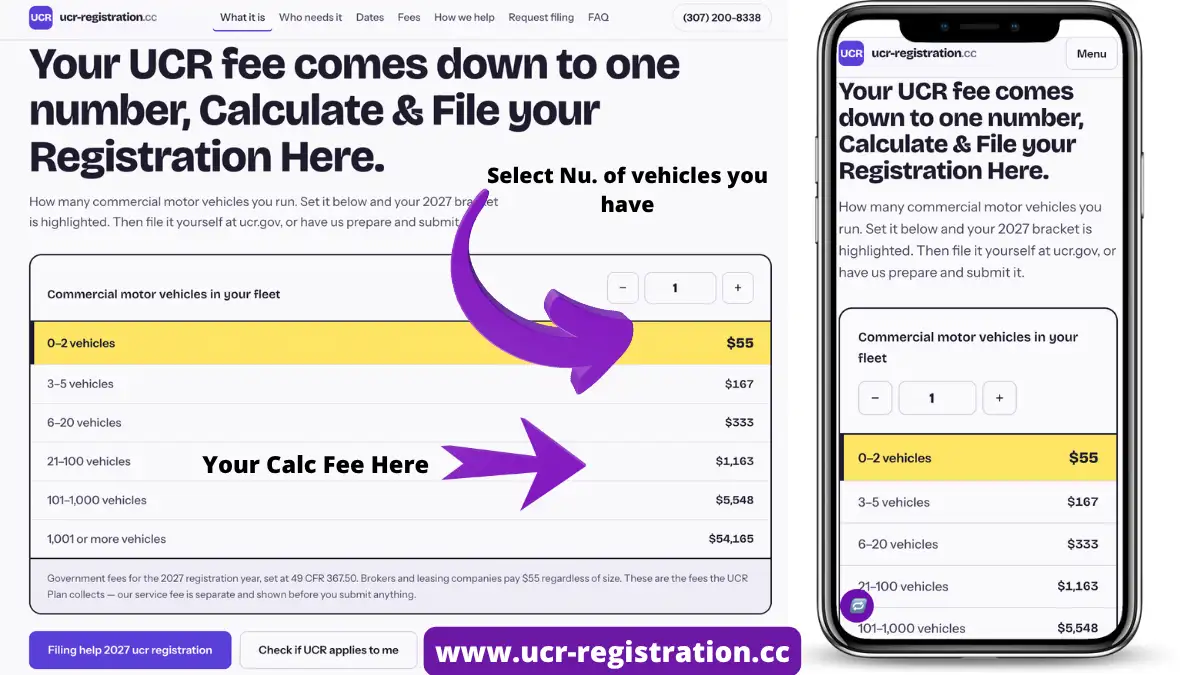
How many commercial motor vehicles you run. Set it below and your 2027 bracket is highlighted. Then file it yourself at ucr.gov, or have us prepare and submit it.
Government fees for the 2027 registration year, set at 49 CFR 367.50. Brokers and leasing companies pay $55 regardless of size. These are the fees the UCR Plan collects — our service fee is separate and shown before you submit anything.
What Unified Carrier Registration is
An annual federal program. Businesses operating in interstate or international commerce register through a base state and pay a fee based on fleet size. The money goes to participating states for motor carrier safety programs and enforcement.
It covers motor carriers, motor private carriers, brokers, freight forwarders, and leasing companies. A broker with no trucks is covered. A carrier running 12,000-pound box trucks is covered.
Not your USDOT number
Getting or updating a USDOT number does not register you for UCR. Different filing, different system.
Not your MCS-150
The biennial update refreshes your FMCSA record. It doesn't touch UCR — though its vehicle count can affect your bracket.
Not a one-time filing
Every registration year is separate. Completing 2026 does nothing for 2027.
FMCSA sets the fee, the UCR Plan runs the registration. That split is where most of the confusion comes from. FMCSA publishes the fee schedule through rulemaking, but you register in the UCR Plan's National Registration System at ucr.gov. Your data flows to FMCSA afterward — which is how enforcement verifies it electronically.
Do you need UCR?
Two questions decide it. Answer them for a quick read — then confirm with the UCR Plan's own free questionnaire before paying anyone, including us.
1. Does your operation cross state lines, or move freight that continues across a state or international line?
2. Which best describes the business?
Answer both questions for a read on your situation.
Things that do not exempt you
- Having a USDOT number. It's a different filing in a different system.
- Running light vehicles. The threshold is 10,001 lbs, not 26,000. And the UCR Plan is explicit that a business with federal MC authority operating only light vehicles still registers — at the lowest bracket. Vehicle size affects what you pay, not whether you file.
- Crossing a state line only occasionally. Interstate commerce isn't measured in trips per year.
- Being based in a non-participating state. Ten jurisdictions don't participate — Arizona, Florida, Hawaii, Maryland, Nevada, New Jersey, Oregon, Vermont, Wyoming and Washington, D.C. That changes your base state, not your obligation.
- Operating no vehicles at all. Brokers and leasing companies are covered.
What counts as a commercial motor vehicle
- Gross vehicle weight rating or gross vehicle weight of 10,001 lbs or more, including with trailing equipment
- Carrying placarded amounts of hazardous materials, at any weight
- Designed to carry more than 10 passengers, including the driver
Units leased for more than 30 days count toward your total.
The real exceptions
Purely intrastate operations, and private carriers of passengers — churches, schools, and businesses transporting their own employees. Those are narrow, and worth confirming rather than assuming.
If you're an owner-operator leased to a carrier
This is the genuinely ambiguous one. If you run under your own authority, you register. If you run under a carrier's authority and your unit is counted in their UCR fleet, they file. That depends on the arrangement — so ask the carrier, in writing, whether your unit is included, and keep the answer.
Confirm it free. The UCR Plan runs an eligibility questionnaire that walks through your situation and gives you an answer. Two minutes, no cost: plan.ucr.gov/do-i-need-to-register
The 2027 dates
Three months to file, then the year begins.
- October 1, 2026
The 2027 registration window opens, and the new fee schedule takes legal effect.
- Oct 1 – Dec 31, 2026
The window to get 2027 done ahead of the year.
- January 1, 2027
The 2027 registration year begins. From here you're operating inside the year, so it needs to already be filed.
- After January 1
You can still file late — the system stays open. Until you do, you're running the year unregistered.
Two years sit on the screen at once each fall. Between October and December both 2026 and 2027 are live in the official system. Read the registration year before you pay. If you meant to file 2027 and the smallest bracket shows $46 instead of $55, you're on the wrong year.
Starting mid-year
If you begin interstate operations in, say, March 2027, you don't wait for the October window. You register for the year you're operating in. The October date governs advance registration, not when you're allowed to come into compliance.
Unified Carrier Registration requirements
UCR applies if two things are true: your business operates in interstate or international commerce, and it's one of five covered types. Everything else is detail.
Who must register
- For-hire motor carriers — moving property or passengers for compensation
- Motor private carriers — moving your own property in furtherance of your business
- Brokers — including brokers operating no vehicles
- Freight forwarders
- Leasing companies
What information you need to file
- Legal business name, as registered with FMCSA
- USDOT number, where applicable to your business type
- Business classification — carrier, broker, forwarder, leasing company, or a combination
- Commercial motor vehicle count, which sets your fee bracket
- Your base state, the one that collects your fee on behalf of all participating states
- A payment method
No documents are uploaded. UCR asks for accurate answers, not paperwork.
How often
Every year. Each registration year is a separate filing with its own fee — completing 2026 does nothing for 2027. There's no mid-year update either: if your fleet changes during the year, that change shows up in the next year's bracket.
What UCR is not
- Not your USDOT number. Getting or holding one doesn't register you.
- Not your MCS-150. The biennial update refreshes your FMCSA record and doesn't touch UCR — though the vehicle count on it can affect your bracket.
- Not your operating authority. Separate application, separate system.
What you get
A receipt, and nothing else. No credential is required in the commercial motor vehicle — compliance is verified electronically. Keep the confirmation filed by registration year, because it's the only proof you hold.
What UCR costs, and what we charge
Two separate numbers. The government fee goes to the UCR Plan. Our service fee is ours. We never blend them into one figure.
Government fees — 2027 registration year
| Commercial motor vehicles | Who it applies to | 2027 fee |
|---|---|---|
| 0–2 | Carriers, private carriers, freight forwarders | $55 |
| 3–5 | Carriers, private carriers, freight forwarders | $167 |
| 6–20 | Carriers, private carriers, freight forwarders | $333 |
| 21–100 | Carriers, private carriers, freight forwarders | $1,163 |
| 101–1,000 | Carriers, private carriers, freight forwarders | $5,548 |
| 1,001 or more | Carriers, private carriers, freight forwarders | $54,165 |
| Not applicable | Brokers and leasing companies | $55 |
These are 2027 figures. The 2026 amounts were lower — the smallest bracket was $46. FMCSA raised fees by an average of 20% in a final rule published September 1, 2026, effective October 1, 2026. If you're budgeting from last year's invoice, you'll come up short.
Our service fee
Charged on top of the government fee, for preparing and submitting the filing. You see the exact amount and the itemized total before you pay anything. If you'd rather not pay a service fee at all, file directly at ucr.gov — that's a legitimate choice and we'll say so.
What changes the fee
- Your commercial motor vehicle count, which sets the bracket
- Your business type — brokers and leasing companies sit in the smallest bracket by statute
- The registration year you're filing for
What doesn't
- How many states you run in. Three states or forty, same fleet, same fee.
- How many miles you ran
- Whether your home state participates in UCR
Where people go wrong
None of these are hard to avoid. They happen because the filing comes round once a year and gets done in a hurry.
- Filing for the wrong year. October through December, both years are live on screen.
- Budgeting from last year's fee. Every 2027 bracket increased.
- Guessing the vehicle count. Long-term leased units count, and the bracket sets the price.
- Treating a card charge as proof. A charge from a filing company means they billed you. It doesn't mean the registration posted.
- Assuming one year covers the next. Each registration year is its own filing.
- Paying a site to check your status. Looking up your own registration at ucr.gov is free.
- Losing the receipt. There's no credential issued, so the confirmation is the only proof you hold.
There's nothing to carry in the truck
The UCR Plan confirms no UCR credential is required in the commercial motor vehicle. Compliance is verified electronically. Keep your receipt with your records anyway, filed by registration year — it's how you answer the question in ten seconds instead of an afternoon.
How filing through us works
Four steps, no surprises in the middle. Nothing is charged until you've seen the total.
-
You send your details
USDOT number, business type, fleet size, and where you're based. Nothing is charged at this point.
-
We check the classification and bracket
We verify the business classification and review your fleet size against the fee tiers, then confirm the itemized total with you — government fee and service fee as two separate lines.
-
We prepare and submit the filing
Your 2027 UCR registration is filed with the correct state selected.
-
You get the confirmation
Your UCR receipt arrives by email. Keep it filed by registration year.
What we handle
- Complete 2027 UCR registration filing
- Verification of carrier or business classification
- Fleet size review for the correct fee tier
- Correct state selection for registration
- Email confirmation and UCR receipt
- Assistance with corrections if needed
What stays with you
- An accurate USDOT number
- An accurate commercial motor vehicle count
- The business type that reflects what you actually do
We file what you give us. If the vehicle count is wrong going in, the bracket is wrong coming out.
Doing it yourself instead
Worth saying plainly: most carriers can handle this alone, and plenty should. File at ucr.gov, pay by card or eCheck, and you pay only the government fee. You'll need your legal business name, USDOT number, business type, vehicle count, base state and a payment method. The UCR Plan runs a helpline at 1-833-UCR-PLAN for questions about the process.
If you know UCR applies, your vehicle count is settled, and you're filing one year — do it yourself. People come to us when more than one year needs sorting out, or when nobody in the office is confident about the classification and fee tier.
What we don't claim
We don't promise a processing time, guarantee an outcome, or act on behalf of any government agency. Registration is processed by the UCR Plan's system, not by us.
An earlier registration year is still open
Each UCR registration year is its own filing. Registering for 2027 does not close out an unpaid 2026 or 2025.
How to tell
Look up your USDOT number at ucr.gov and check each year separately. Checking costs nothing.
Common reasons a year goes unfiled
- The person who handled it left and nobody picked it up
- A filing company took payment but the registration never posted
- The business has more than one USDOT number and the wrong one was used
- A mailed check arrived after year-end and nobody followed up
- Someone filed the current year and assumed it covered the gap
We handle prior-year filings the same way as current-year ones. Each year is priced separately, because each is a separate government fee. Mention the years in the form below and we'll sort out what's actually open.
File current year 2026 ucr registration
File previous year registration 2025
Request UCR filing help for 2027
Tell us about your operation and we'll prepare and submit your filing. Nothing is charged from this form — we confirm your details and total first.
You don't have to use us. You can file this yourself at ucr.gov and pay only the government fee.
Questions people actually ask
Do I have to use a private service to register?
No. You can register directly with the UCR Plan at ucr.gov and pay only the government fee. This site is a private, paid service. We'd rather tell you that plainly than have you find out later.
When does UCR registration for 2027 open?
October 1, 2026. The 2027 registration year itself begins January 1, 2027, so the window to get it done ahead of the year runs October through December.
How much is UCR for 2027?
Government fees run from $55 for 0–2 vehicles to $54,165 for 1,001 or more. Brokers and leasing companies pay $55. Our service fee is separate and shown before you pay.
Does my USDOT number cover UCR?
No. UCR is a separate annual filing in a different system. A current USDOT number or a recent MCS-150 update does not register you for UCR.
Is there a UCR card to carry in the truck?
No. The UCR Plan confirms no UCR credential is required in the commercial motor vehicle. Compliance is verified electronically. Keep your receipt with your records anyway.
Does filing one year cover the next?
No. Each registration year is separate, with its own filing and its own fee. Completing 2026 does nothing for 2027.
My trucks are under 26,000 pounds. Am I out?
Probably not. The UCR threshold is a gross vehicle weight rating or gross vehicle weight of 10,001 pounds or more — much lower than most operators expect.
I'm a broker with no trucks. Do I register?
Yes. Brokers are covered and pay the smallest bracket, $55 for 2027. Leasing companies are in the same position.
My state isn't in the UCR program. Am I exempt?
No. Ten jurisdictions don't participate, including Florida, Maryland, New Jersey and Wyoming. If you're based in one, you register through an assigned base state instead.
Does my fee go down if I only run a few states?
No. The fee is based on fleet size and the fact of interstate operation, not the number of jurisdictions you touch.
My fleet changed mid-year. Do I file an update?
No. There's no mid-year supplemental filing. The change is reflected in the following registration year's bracket.
How do I check whether a year is already filed?
Look up your USDOT number at ucr.gov and check each registration year separately. Checking is free. If a site charges you to check your own status, it isn't the official system.
How to work out your UCR fee
The calculator above needs one input, and getting that input right is the whole job. Here's how to count.
Step 1 — Count your commercial motor vehicles
A vehicle counts toward your bracket if it meets any one of these:
- Gross vehicle weight rating or gross vehicle weight of 10,001 lbs or more, including when connected to trailing equipment
- Carries placarded amounts of hazardous materials, at any weight
- Designed to carry more than 10 passengers, including the driver
Include units you've leased for more than 30 days. Your count comes from the vehicles reported on your most recent MCS-150, or the total you owned and operated during the 12-month period ending June 30 of the year before the registration year.
Step 2 — Check your business type
Brokers and leasing companies sit in the smallest bracket by statute, whatever their size. A brokerage moving thousands of loads a year pays the same $55 as a two-truck operation. Freight forwarders that operate no vehicles are assessed at the lowest category; those that run vehicles are assessed by fleet size.
Step 3 — Set the number in the calculator
Your bracket highlights. That figure is the government fee for the 2027 registration year, collected by the UCR Plan.
One number, one fee. That's the entire calculation. There's no mileage formula, no per-state charge, and no adjustment for how much freight you moved.
Three things that don't change what you pay
- How many states you run. A carrier operating in three states and one operating in forty pay identical fees if their fleets match.
- How many miles you turned. UCR isn't mileage-based.
- Whether your home state participates. Ten jurisdictions don't — that changes which state collects your fee, not the amount.
Worked examples
| Operation | Counts as | 2027 fee |
|---|---|---|
| Owner-operator, one tractor, own authority | 1 vehicle | $55 |
| Two box trucks at 14,000 lbs GVWR | 2 vehicles | $55 |
| Four trucks owned, one leased 6 months | 5 vehicles | $167 |
| Freight brokerage, no vehicles | Lowest bracket by statute | $55 |
| Regional fleet, 34 power units | 34 vehicles | $1,163 |
| Carrier with 9 CMVs and 3 pickups under 10,001 lbs | 9 vehicles | $333 |
Where the count usually goes wrong
- Using 26,000 lbs as the threshold. It's 10,001. That catches box trucks and heavier vans most owners don't think of as commercial motor vehicles.
- Leaving out long-term leases. Units leased more than 30 days belong in the total.
- Counting trailers. The bracket is based on power units.
- Using a stale MCS-150 figure. If your fleet has changed since you last updated it, the number on file may put you in the wrong bracket.
- Counting vehicles that run intrastate only, when the question is your interstate operation.
If your count sits near a bracket edge — 2 versus 3 vehicles, or 20 versus 21 — it's worth settling the number properly before you file. That's the difference between $55 and $167, or $333 and $1,163.
Successfully On time Registered UCR one of our happy Customer.
Who runs this site
DotMotusCompliance Inc, a private, for-profit compliance assistance company based in Owatonna, Minnesota.
What we are
A paid filing service. Carriers and brokers send us their details, we prepare and submit UCR registrations, and we charge a fee for doing it. That's the whole business.
What we are not
Not FMCSA. Not USDOT. Not the UCR Plan, a state agency, or any other government body. No government authorization, endorsement or affiliation of any kind. The domain name of this site is not a government address.
You are never required to use a service like ours. Registering directly at ucr.gov costs the government fee and nothing more, and checking your registration status there is free.
Our main site, with longer guides on UCR and other DOT filings: dotmotuscompliance.com
Talk to our Expert
Calling is usually fastest, especially if you're not sure which registration years are open.
Phone
(307) 200-8338
Monday to Friday, 7 AM to 7 PM Central
Support@DotMotusCompliance.com
We reply during business hours.
DotMotusCompliance Inc
202 N Cedar Ave Ste #1
Owatonna, MN 55060
Official UCR help
For questions about the program itself, the UCR Plan runs a helpline at 1-833-UCR-PLAN (1-833-827-7526).